Showing posts with label Posted by Alyssa. Show all posts

Wednesday, April 8, 2020

Alyssa's Writing Self-Assessment

Over the course of this semester, my writing has certainly improved. Back in January, I noted that my main weakness was my inability to really sit down and put words on the page in a timely manner before the due date. While I definitely still struggled with that aspect of the writing process, I was more focused this semester on making it less of a struggle. The thing that helped me the most to overcome this weakness was writing down what my primary claim was for each paper. This gave me a clear direction to take my ideas, and made it easier for me to make an outline and talk about the most important parts of my argument with the help of specific sources that supported what I was saying. In this last paper especially, I feel that my ideas were more clearly outlined because I had a clear thesis statement, making it possible for me to start the essay with a better sense of direction and organization. 

Though I made considerable progress in focusing my ideas and hence in making it easier for me to find the motivation to start writing, I found that I still have other areas to improve upon in the writing process. In particular, I saw that I have the tendency to write long, flowing sentences without a break in between to let my reader take a mental breath of air. This is a challenge that I’ve been aware of, but it hadn’t been quite so obvious to me as when I was editing this final paper. I had to cut out several sections to make my paragraphs more comprehensible and concise. 

One of the  most enjoyable parts about researching and writing the final paper for this class for me was learning how to use the resources available to us through the BYU library, as well as through the other non-scholarly sources on the internet. I loved finding books on obscure aspects of Anglo-Saxon society that enriched my understanding of how the text I analyzed fit in to the community, and it was a true blessing to find the full performance of a play that related directly to the subjects I focused on. It was really fun to read and watch other people’s interpretations and reactions to the literature I was studying, especially when the people talking about it were just including it in their regular discourse. 

Something that I really think helped me to formulate my ideas about the texts I analyzed in the final paper was just talking about it with my friends and family. Even though I already had the ideas in my head, it helped to explain them to someone else and get their feedback and perspective. It also made me feel like I wasn’t just writing for the sake of writing, but that someone out there might have genuine interest in what I was writing about. Their support and enthusiasm made me get even more excited about my paper so that it felt less like an assignment for a class and more like a personal project that I wanted to invest in.

Tuesday, March 24, 2020

Alyssa's Current Research Questions

I’m working on connecting the portrayals of Judith and Dr. Faustus in the Old English poem Judith and the Renaissance play Doctor Faustus to the superhero propaganda during World War II. I will probably argue that the superhero and supervillain archetypes are more effective as a means of dividing, rather than uniting, a people.


Questions:
  • Where can I locate pamphlets or periodicals that reference Protestant or Catholic beliefs in the 16th century?
  • Where should I look for historic interpretations of the conflict between the Anglo-Saxons and the Vikings in the 10-11th centuries?
  • Where can I find literary criticism on WWII comics?

Monday, March 23, 2020

Alyssa'a Annotated Bibliography on Dr. Faustus and Judith

Working Annotated Bibliography

So far my research has directed me towards the religious and cultural influences on the language used during the Anglo-Saxon and Renaissance periods of England. Because both Dr. Faustus and Judith center around religious practices and beliefs, I wanted to explore how Christianity and types of Christianity are portrayed in both of these texts, and see if there was any connection between each presentation.

[Scholarly source via an email exchange with a professor]
Bosworth-Toller Anglo-Saxon Dictionary. Charles University in Prague, 2010, http://bosworth.ff.cuni.cz/. Accessed 23 March 2020.I used this dictionary last semester to help me write on and Old English text, and it is quite helpful in giving possible translations and meanings of Old English words and phrases. I intend to use this to help me decipher the intentions surrounding Judith's writing and analyze the formal elements of the poem.

[BYU English Literatures database]
Chickering, Howell. “Poetic Exuberance in the Old English Judith.” Studies in Philology, vol. 106, no. 2, Spring 2009, pp. 119–136. EBSCOhost, search.ebscohost.com/login.aspx?direct=true&db=prf&AN=37180756&site=prc-live.This essay discusses the formal elements of Judith, especially how the tone of the poem influences its meaning and message to the reader. I find it interesting that the author used the word "exuberance" to describe the poem's formal qualities; I think it will be interesting to further explore the implications of the celebratory language in the text as a potential form of propaganda.

[The BYU Library database page]
MARSHALL, PETER. "The Reformation of Hell? Protestant and Catholic Infernalisms in England, c. 1560-1640." The Journal of Ecclesiastical History 61.2 (2010): 279-98. ProQuest. 23 Mar. 2020 .This paper differentiates the Catholic and Protestant versions of hell. Because the concepts of heaven and hell are so central to Dr. Faustus, I want to look at the play to see how Marlowe portrayed each, and whether this portrayal aligned more with the Catholic or Protestant version of the afterlife. Knowing which version he used of heaven and hell will help me to gauge how this play would have been received by his mostly-Protestant English audience.

[Amazon]
Marlowe, Christopher. The Tragical History of Doctor Faustus, Harris, John D. E-book, John Harris, dba, 2018.This annotated version of Dr. Faustus gives insight into the legend of Dr. Faustus and the deliberate changes Marlowe made to the story for a mostly Protestant English audience. The editor has made some comments on the ironic play on words that Marlowe has made in Faustus' name, and notes some allusions to other faustian figures in that time period.

[E-book through BYU's library page]
The Anglo-Saxons : Synthesis and Achievement, edited by J. Douglas Woods, and David A. E. Pelteret, Wilfrid Laurier University Press, 1986. ProQuest Ebook Central, https://ebookcentral.proquest.com/lib/byu/detail.action?docID=685986.This book explores the different kinds of propaganda used to tell the history of the Anglo-Saxons in England (such as the Bayeux tapestry, though this was woven after the Norman conquest), as well as discusses the culture of the Anglo-Saxon period during the time that Judith was probably written. Since the Anglo-Saxons were trying to unite the people of the country (which the Anglo-Saxons themselves had invaded just a few centuries earlier) against the Vikings, this book is particularly interesting to use as a filter for what kind of characteristics are applied to the heroine Judith.

Monday, March 9, 2020

Alyssa's Reflection on Literary Analysis 2


  • Informal, online, or multimedia resources:
    • This part of developing my paper is one that I hadn’t expected to be as useful to developing my argument, but turned out to be quite influential in the way that I wrote the paper. Looking at different portrayals and stage interpretations of Dr. Faustus helped me to see perspectives different from the one that I had developed after reading the script and stage directions. I enjoyed looking at the artwork of specific scenes in the play as well as the different approaches that different theater companies took in their performances. The main source that I used here was the Globe Theater’s production of Dr. Faustus, which I found to be a far more comical and symbolic interpretation than I had initially read in the text. The actors’ performances and interpretations of their characters had a great impact on how I wrote about the psychology of the titular Dr. Faustus.
  • Literary theory:
    • I chose to use the psychoanalytical approach to Dr. Faustus because it was different from the other approaches that I was more comfortable using, and I thought it would be a good exercise. As it turned out, this literary theory was just as helpful in highlighting the import of the soliloquies and the symbolic characters that I had chosen for formal analysis. Looking at these aspects of the play through a psychoanalytical lens helped me to make the connections between the form and my interpretation of it more clearly visible. Because the formal elements I was examining were indicative of the mindset of the character, using the psychological theory just made sense to use. 
  • Writing process:
    • My writing process has changed a bit since the beginning of the semester. Before, I would write when I could, and often spend too long self-editing the paper long before I ever finished it. Having a specific time to write, as we did for this assignment, was helpful for me to focus my thoughts and get the words onto the page that I needed to write down. Being accountable to someone else for the work that I did was also helpful, as it kept me focused on what I needed to do and made me less liable to getting distracted. I still needed to take a little extra time to write after spending perhaps too long on looking for good sources to support my argument, and I feel that this is where I can most improve in my writing process.


Friday, February 21, 2020

Critical Approaches to Dr. Faustus

Dr. Faustus is a play by Christopher Marlowe, written around the same time as Shakespeare was writing his plays. It follows an accomplished doctor, Faustus, who desires greater power and influence, and makes a pact with the devil to achieve these ends. When I read Dr. Faustus the first time, I was fascinated by the discussion about the realities of heaven and hell, and whether we ourselves are responsible for our damnation or salvation.

Postcolonialism: At the time that Marlowe wrote Dr. Faustus, Europe was eagerly looking for new territories to conquer, and countries like Spain and England had already sent men across the Atlantic in search for resources that would enrich their kingdoms. In Dr. Faustus, the same obsession over gaining riches and power infects Faustus. Although he obtains his object, Faustus eventually has a tragic and hellish fall into the realm of the devil, losing all material things he had acquired.
Source Studies: By reading a few versions of the original Faust myth, I may see how Marlowe remained faithful to the original tales and how he changed some details to better appeal to his English audience. With this comparison, I may also draw some conclusions about the cultural perceptions of magic and morality in Germany and England.
Marxism: There is a lot of power play in Dr. Faustus: the power Faustus believes he has over the spirits of hell; how Faustus uses his magic to scare and toy with the uneducated; the power the uneducated class wants to obtain through magic; and the power that Lucifer holds over Faustus. How does each group view and use the power they have to achieve their own ends?
Christian Criticism: In a play that discusses so openly belief and unbelief, I would be remiss if I did not look at the characters’ relationships with religion and how their beliefs affect their actions. In particular, I could look at Faustus’ constant wavering between faith and doubt in God and the devil and how his uncertainty leads to his downfall. How was this received in a protestant audience?

Wednesday, February 12, 2020

Alyssa's Exploration Report

I chose to do my informal exploration on The Tragical History of Dr. Faustus, by Christopher Marlowe, one of the texts I read for a past class. One of the first sources I found was a very interesting BBC article written in 2017 that discusses how contemporary politicians make their own deals with the devil, so to speak, and so gain as much power and influence as they like without really doing much good for the communities they represent. It touches on the concept of instant gratification in our modern culture as well, and how technology is one of the driving forces for our constant need of something pleasurable now without thinking of the long-term consequences. On YouTube, I discovered the full performance of the play at the Globe Theater, and watched some of it. The actors’ and director’s interpretations of the text were quite vivid and made the comical elements of the play all the more so. They really highlighted Faustus’s internal dilemmas in a way that made the audience almost sympathize with him for his choices and their consequences. When I made the syllabus search online, I found myself in the midst of student responses to the text, which included some connections to other works of literature I hadn't considered. A search on Pinterest yielded several depictions of Faustus conjuring and making his deal with Mephistopeles.

Monday, February 10, 2020

Alyssa's Reflection on Literary Analysis 1

Prewriting is often where I most frequently freeze, without the motivation to continue on to the next stage of putting words down on the page. However, the prewriting and thesis techniques that we used for this writing assignment were helpful in directing me toward one train of thought that I was excited about, and it was consequently easier to write on that topic. The general research we did was especially helpful for me, and largely shaped my main claim. It was a much less stressful experience finding sources and including them in my writing for this assignment than with past essays.

Wednesday, January 29, 2020

General Literary Resources - Genre Reference Works - Alyssa Ip

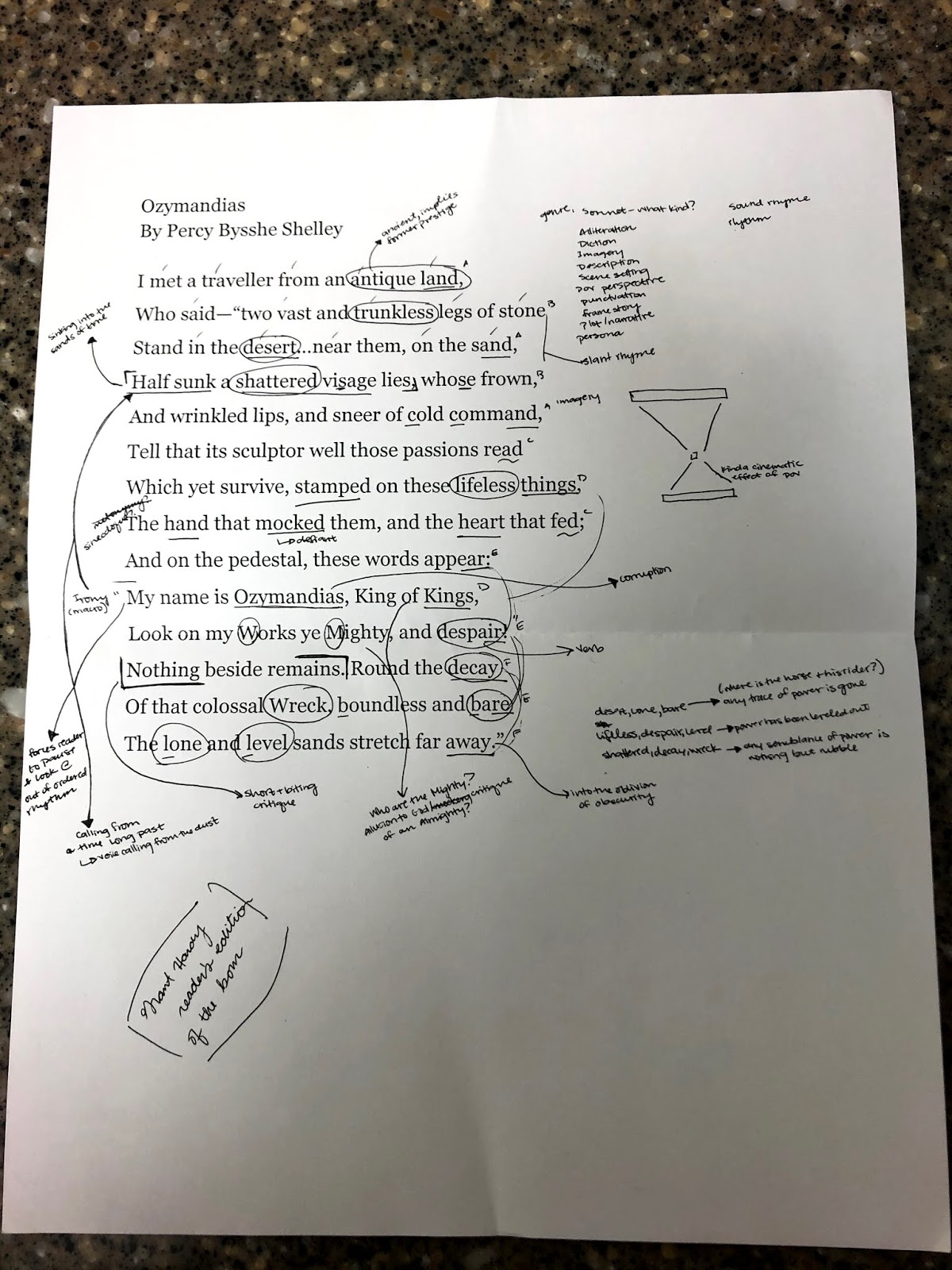
My assignment requires that I find a particular resource to help in the study of Percy Bysshe Shelley's poem "Ozymandias." I have been tasked with discovering genre reference works, in the hopes that knowing more about the typical conventions of this type of poetry will aid me in discussing Shelley's work with better understanding and meaning. The following sources are what I have found:

William Harmon, A Handbook to Literature
Since this book is a good starting reference for all things literature-related, it is here that I began my search. Several copies of this book may be found on the fifth floor of our university’s library. This resource includes several helpful entries not only on poetry, but also on the sonnet as a subgenre of poetry as well as insight on Romanticism as a creative period. Broadly speaking, poetry “adds to our store of knowledge or experience” by expressing thoughts in rhythmic, imaginative, and concrete ways. As a form of poetry, the sonnet has developed from two different types, the Petrarchan (or Italian) and the Shakespearean (or English) sonnet. Its form was first practiced in the thirteenth century in Italy, and increased in popularity throughout the Renaissance. The Romantic movement in the late eighteenth and early nineteenth centuries is characterized by rather poetic social values; the imaginative, natural, primitive, and mystical aspects of life were more greatly emphasized in the arts, and a deepened “sympathetic interest in the past” arose. 
Though at first sight strikingly similar to the first, this source not only willingly revealed the differences between the Italian and the English sonnet, but also expanded a bit on the history of the form. I found this resource while searching the databases on the BYU library website. The entry I found describing the specifics of sonnets details the various changes made over the centuries to this type of poetry. The Italian Petrarch established this style of writing poetry in the fourteenth century, with the subject matter typically centering around love, especially courtly love. It was so popular that the sonnet expanded to Spain, France, and England during the Renaissance, and eventually to Germany. During the succeeding eighteenth century, the sonnet’s popularity waned, but was again brought forth by the hands of some of the Romantic poets, including Keats and Wordsworth.

I think it is rather interesting that this particular form of poetry fell in popularity during the eighteenth century and then resurfaced with the Romantics, the time period that Shelley wrote in. Given this context, perhaps "Ozymandias" could be seen as an ode to what once was in view of the dawning century.

Monday, January 27, 2020

Heartfelt Treasure

By Alyssa Ip

"Wherever your heart is, that is where you'll find your treasure."
- Paulo Coehlo, The Alchemist

It seemed to me the coldest day of the year on the day I left for the desert. Outside lay all the evidence of what the residents in my hometown called “snowmageddon”: snow so thick and white weighing down the tree boughs until I thought it a miracle they wouldn’t break; topping all the houses with a frozen frosting that dripped off the rooftops in icicles that nearly pierced the ground; and spilling over from vainly shoveled driveways into streets and walkways, covering them all in a dense layer of winter wonderland. This was the day that I took my leave of all of the familiar people and places of home and stepped into the unknown.

Wednesday, January 15, 2020

Alyssa's Literary Moments

A childhood friend [Personal Literature]
When I was around 8 or 9 years old, I came home from Barnes and Noble with A Little Princess in my arms. As I read, I found that I could connect with Sara Crewe more than I had with Amelia from Amelia Bedelia or any of the Littles from the book series. I felt that Sara and I, much like Sara and Emily in the book, had some kind of special connection and friendship. Since then I have carried Sara Crewe around with me from house to house and from home to school. She has become one of my very good friends.


Girl meets reality [Cinematic Literature]
In 2011, my mom and I went to go see The Help in the dollar theater near our home. My mom had read the book, as had I, and we were excited to see how it all played out on screen. As the story unfolded before our eyes, I could feel a greater connection not only to the characters in the film, but also to that particular time in our history. To see the people and events come to life before my eyes in a very real and almost visceral way impacted me in a similar way. After the film, I came to understand that the world is a much more complex place than I had previously supposed.


Happy birthday, Mom [Literary Letter]
Sometime in my late childhood/early teen years, I decided that instead of buying gifts for birthdays and Christmas and other occasions, I would write a poem tailored to the person I was writing for. These poems became love letters of a kind, especially when they were written to my family members. I wrote one of these poems for my Mom on her birthday, in it describing all of the wonderful things about her that I knew from experience or stories and imbuing all the love I had for her. This was the one gift that made her cry. 


An unexpected poetic line [Religious Literary Experience]
During the year that we studied the Book of Mormon in seminary, I strove to faithfully do my scripture reading every day. Early on in that experience, I remember reading the eighth chapter of 1 Nephi, when Lehi is describing his exceptional vision of the tree of life. At the start of that episode, he describes a “large and spacious field” that stands near the iron rod leading to the tree of life “as if it had been a world.” In my 16-year-old mind, that last line was the “most poetic scriptures I have ever read.”


Lord of the---not---Rings? [Discussing Literature]
One of the main complaints about high school English classes is that students are compelled to read books that are too old, too thick, and too full of hidden meanings that completely destroy any hope of actually enjoying the book. When my sophomore class read Lord of the Flies, I hoped for something better. As it turns out, I discovered while reading this book that the thinly veiled imagery and allusions and metaphors actually did help me to better understand the novel, or at least make a connection to my own store of knowledge. As we talked about what we found in class, the discussions centered around the possible allegorical nature of the novel, and we all walked away more satisfied than we expected.


Girl meets reality part II [Literary Coping]
The transition from mission to home is a difficult one, and it was no less difficult for me. I relied on structure and consistency, and it seemed like my entire framework of living had been knocked to the ground. My friend gave me a copy of The Alchemist when I came home, and I devoured it in two days. It was the best gift anyone has given me. In its pages I discovered the truth that change is the one consistent part of living, and that even through changes, especially hard ones, we still can retain our personal purpose and fulfill that purpose by continuing to move forward.

Monday, January 13, 2020

Alyssa's Academic Writing Self-Assessment

It is extremely typical of me to begin an academic paper (or any paragraph within that paper) with one sentence, erase it, write another, erase it, and then write another, only to hit the backspace an inordinate amount of times in frustration. Even though I do very well in planning out my essays and noting down which quotes from sources will go in which paragraph and how each point of my argument will connect with the next, I struggle with starting to put the words on the page. At certain times (like a couple nights before the due date) inspiration will strike, and words will flow from me like water from a fountain. But then, of course, editing that deluge becomes something of a secondary priority. For example, the final paper in my English 291 class required me to do some research on a piece of medieval literature and then analyze the text through a formal lens. This paper boasted an incredibly detailed outline with gorgeous notes next to each quotation and citation. But it took me at least three days to come up with the sentences that would build something more solid from the framework for the paper.