Showing posts with label Posted by Sophie Plantamura. Show all posts

Tuesday, April 7, 2020

Sophie's Writing Self-Assessment

I think that my writing has developed quite positively over the course of this semester. I felt that the biggest help was the way we really got into our topics through deadlines that forced us to draft at least a couple times. I usually don’t go through a paper so many times, and by sticking with the same topic for my final paper as with Lit Analysis 2, I was able to really dig deep into both my topic and my writing. I think that the fact that I had already come up with my idea/thesis in the second paper made my writing of the final paper a lot more enjoyable since my least favorite part of writing a paper is coming up with the idea. I have learned that once I really narrow in on a topic, I actually enjoy the research that comes along with it, and I like to prove my point in a paper. I also liked the specificity I was able to employ when it came to earlier papers, like the “Ozymandias” paper. I got better at digging into the formalist aspects of text while also keeping in mind general characteristics, like genre.
It’s funny looking back at my initial self-assessment: I wrote that my biggest weakness was coming up with ideas, and I said the same thing in the previous paragraph without even realizing. I guess I’m still not loving the beginning process of writing a paper, but I learned some good techniques through this class. For example, I found the inspiration for my final paper through blogs and other informal media sources. I have learned that this is a great way to generate ideas, even for scholarly research. In the future, I will make sure to search through non-scholarly sources in order to find inspiration for papers that I’m trying to write. I also think that I have improved in staying focused on a claim, especially in doing so in a longer research paper.
This class has really taught me how to dive into English research. Because my major is actually Political Science and English is one of my minors, I am a lot more experienced with conducting political science-related research. But, I have found that there are many helpful databases and resources to aid in research related to literature. Through my final paper topic on the environment and climate change, I discovered that I can use literature to learn about things that I am passionate about through a different lens than I would through other disciplines. For example, if I was researching the environment through political science, I would probably find a ton of resources about partisan policies and the international struggle to alleviate climate change. Yet, by researching the environment through the lens of The Handmaid’s Tale, I was able to learn more about the topic in the less-partisan context of literature, in a way that reflects the possible future of the Earth. 

Tuesday, March 24, 2020

Sophie's Current Research Questions


  1. I'm working on reading The Handmaid's Tale through an ecocritical lens and showing that Atwood's goal is to warn of the dangers of climate change. I am also considering integrating a more ecofeminist perspective by incorporating works by seventeenth century English poets. 
  2. Three research questions: 
    1. What is the best way to find newspaper sources (specifically from Canada in the 1980s)?
    2. Where should I look for classic/general ecocritical essays so I can learn about how others have used ecocriticism? 
    3. What are the best general historical sources that can help me understand the context of when Atwood was writing? 
Thank you!

Saturday, March 21, 2020

Sophie's Annotated Bibliography on Ecocriticism and The Handmaid's Tale

Working Annotated Bibliography: The Handmaid's Tale

Through researching The Handmaid's Tale, I have found that an ecocriticial analysis of this seemingly unenvironmnetal novel is not all that far-fetched. There are a few scholarly essays out there analyzing The Handmaid’s Tale in a similar way, bolstering my argument and providing some good quotes and ideas to expand on. I also have enjoyed researching historical sources since they provide very interesting insight into the context surrounding Atwood when she was writing, and I hope to find more of these sources in subsequent research.

1. [newspaper found through library database/proquest]
"Environment Canada Reports One Acidic Rainfall Last Week: [FINAL Edition]." The Gazette, 1985, p. A.2. Global Newsstream. Web. <https://search-proquest-com.erl.lib.byu.edu/docview/431229881?accountid=4488>.
This is a straightforward news article that reports an acid rainfall in Canada in 1985. At this time, worries about pollution and toxic waste were at an all time high, and the world was beginning to see the consequences of human behavior. Margaret Atwood was especially interested in the impact of human pollution and waste on the environment, and knowing that almost fiction-like events were taking place at the time Atwood was writing The Handmaid’s Tale underscores the environmental aspect of the book.

2. [e-book found through HBLL] Joshua, Suka. “An Ecocritical Investigation of Margaret Atwood’s Futuristic Novels.” Essays in Ecocriticism edited by Nirmal Selvamony, Nirmaldasan, Rayson Alex, Sarup & Sons, 2007, pp. 207-215. As the name implies, this e-book was a compilation of essays analyzing works of literature through an ecocritical lens. The essay that I focused on was an ecocritical investigation into Margaret Atwood’s novels, including The Handmaid’s Tale, making it an extremely helpful source for my essay.

3. [article found through LION database) Hooker, Deborah. "(Fl)Orality, Gender, and the Environmental Ethos of Atwood's the Handmaid's Tale." Twentieth Century Literature 52.3 (2006): 275-0_6. Literature Online. Web. This scholarly article analyzes The Handmaid’s Tale from an ecofeminist lens, focusing on Atwood’s descriptions of flowers and nature. Although this was not the focus of my paper, some of the points made in the article were very helpful to understand how one reads The Handmaid’s Tale ecocritically, and I was able to establish a broader understanding of ecocriticism.

4. [dissertation/electronic thesis from Gale Literature Database]
Ketterer, David. "Margaret Atwood's the Handmaid's Tale: A Contextual Dystopia." ScienceFiction Studies 16 (1989): 209-17. Gale Literature Criticism; Gale. Web.
Although this essay is not focused on the ecocritical aspects of The Handmaid’s Tale, it explains the context surrounding the writing of the book as well as in the book itself. Since ecocriticism lends itself well to setting and historicism, this essay was very helpful in establishing an understanding of the context surrounding The Handmaid’s Tale and how I can relate it to ecocriticism.  

5. [non-textual source (image) found through Google Images]

This image is from season 2 of the Hulu adaptation of The Handmaid’s Tale. It is of a woman in the Colonies, a toxic wasteland where infertile/disobedient handmaids are sent to dispose of bodies and clean up pollution. She is wearing a gas mask because the air is so toxic and full of chemicals, making the Colonies uninhabitable and lethal. This exhibits the destruction of nature that Atwood illustrates in The Handmaid’s Tale on a visual level. 


Monday, March 9, 2020

Sophie's Reflection on Literary Analysis 2


  • Informal, online, or multimedia sources
Informal sources gave me the original idea for my entire paper. I found the idea about climate change and The Handmaid's Tale in a blog post, and I was able to build on that through using other sources and critical approaches. In my paper, I used a lot of different blogs about The Handmaid's Tale and environmentalism; they had some great quotes and ideas that I really built my paper around. Additionally, I used the idea of the Hulu series about The Handmaid's Tale to gain a different/illustrated perspective than I had just from reading the book. 
  • Literary theory
I did not know that ecocriticism was a critical theory, but when I found out about it, I immediately knew that I wanted to learn more. As a political science major, I'm super interested in environmental issues, and I think that viewing a text through an ecocritical lens can reveal some important insights that would not be obvious otherwise. On the other hand, though, ecocriticism was not the easiest theory to blend with formal analysis since it does not exactly lend itself to form, at least in The Handmaid's Tale. Once you start looking at a text through an ecocritical lens, though, environmental ideas seem to appear everywhere.
  • Writing Process
I found reading my draft out loud to be very helpful in catching errors, restructuring organization, and aiding flow. I also thought that this time, I was a lot stronger in my drafting process than I usually am. Usually, I just write a draft and make minimal changes before submitting. This time, I reorganized my paper many times before submitting, trying to make sure it was the best possible organization. I feel that I could get stronger in knowing exactly what I am trying to argue and being more focused rather than using all of the information available. 

Friday, February 21, 2020

Critical Approaches to The Handmaid's Tale

Recently, I've tried to upgrade my usual personal reading list of courtroom thrillers and young adult novels to critically acclaimed fiction. One of these added books was The Handmaid's Tale by Margaret Atwood. I read this in the beginning of the semester and absolutely loved it, and the fact that the novel holds literary recognition inspired me to do my own literary analysis on it.
  • Ecocriticism: I can look at the way The Colonies (a toxic wasteland where "Unwomen" are sent to labor) reflects contemporary climate change today. The Colonies perhaps represent what will happen to our Earth if climate change is not mitigated, and the nonchalance and inevitability with which The Colonies are viewed in Gilead may warn against the idea that climate change is not a man-made disaster. 
  • Feminism: I would hope to do an intersection between ecocriticism and feminism by looking at the ways that women are compared to nature: young girls are repeatedly told that they are fruit, flowers, or similar natural resources in The Handmaid's Tale. This characterization could reflect how man views women as the next fertile resource to use up after they destroyed the natural environment.
  • Marxism: Even in the dystopian world of The Handmaid's Tale, class conflicts permeate the totalitarian culture. I could compare the social status of Commander's wives, Aunts, the Handmaids, Marthas, Econowives, and Unwomen. 
  • Psychological: Using Freud's or Jung's ideas of the collective unconscious, I could view the experiences of the Handmaidens through a psychological lens and analyze the psychological impact of their treatment. 
  • Christian Lit: The Handmaid's Tale has many Christian themes, especially relating to the function of women and the sanctity of life. It also has some interesting (and critical) descriptions of religion in the dystopian Republic of Gilead, which could pose an interesting comparison to Christianity. 

Wednesday, February 12, 2020

Sophie's Exploration Report

I chose to explore informal sources on a book I read recently, The Handmaid's Tale by Margaret Atwood. Because this novel was made into a critically acclaimed series on Hulu, it has a wide online and informal audience who analyze both the book and the adaptation. This allowed me to find a lot of different sources and encouraged me to watch the series, but it also introduced the difficulty of finding discussions about the book rather than always the series.

My first informal search was just on Google Images, where most results were photos of the main character, Offred, in the Hulu series. But through clicking through these images, I found an interesting article about The Handmaid's Tale statement on climate change. Usually, analysis of the novel focuses on gender roles and reproductive rights, so I thought the new perspective that this article took was very interesting.

Finally, through searching syllabi that include The Handmaid's Tale, I unsurprisingly found the novel on a lot of syllabi for English and Literature classes, but also discovered it on syllabi for Women's Studies and Sociology classes, which added an interesting dimension to my understanding.

Sources:
https://www.bustle.com/p/the-handmaids-tale-is-trying-to-warn-you-about-climate-change-18667636
https://www.hulu.com/series/the-handmaids-tale-565d8976-9d26-4e63-866c-40f8a137ce5f
https://www.google.com/search?q=site%3Aedu+syllabus+the+handmaid%27s+tale&oq=site%3Aedu+syllabus+the+handmaid%27s+tale&aqs=chrome..69i57j69i58.7234j0j8&sourceid=chrome&ie=UTF-8

Monday, February 10, 2020

Sophie's Reflection on Literary Analysis 1

The prewriting process that we did during and outside of class actually helped me immensely in writing this paper. I usually have the most difficulty deciding what I want to focus on and constructing my thesis. The fact that I basically had my thesis written and ideas outlined when I started my paper made the process go a lot smoother, and I felt more organized than usual. Also, it was helpful having so many sources of research done by my classmates which showed me the value of writing through a shared platform. Overall, writing this paper was a much better experience than I usually have.

Tuesday, January 28, 2020

General Literary Sources - Encyclopedias and Guides - Sophie Plantamura

My task is to find specific resources that will aid my study of Percy Bysshe Shelley's poem, "Ozymandias." I was assigned to focus on encyclopedias and guides. By researching basic overviews of Shelley's poem, I was able to gain a more comprehensive understanding of the context surrounding "Ozymandias" and how this impacts the textual meaning. Here is what I found:

  • The Oxford Dictionary of Phrase and Fable 
Through simply searching "Ozymandias" on the Oxford Reference website, I was able to find a quick reference to the poem from The Oxford Dictionary of Phrase and Fable. This entry explains that Ozymandias was the prenomen, or throne name, of Ramses II of Egypt. I had assumed that Shelley had just made up the name Ozymandias, but I now understand that it was based on an actual pharaoh. Furthering my understanding, the entry says that a colossal 57-foot statue of Ramses II once stood at Thebes, but now survives only in fragments. On the actual statue, the inscription reads "My name is Ozymandias, king of kings: Look on my works, ye Mighty, and despair!" I had no idea that this culminating line of Shelley's poem was actually written on a real statue; this fact illustrates that Shelley had to work around this line to create the rest of the poem. The Egyptian history behind the poem provides insight into Shelley's writing process which only deepened my curiosity. 

  • Overview: "Ozymandias" from Poetry for Students (Vol. 27), edited by Ira Mark Milne
On Gale's Literature Resource Center, I did a search for "Ozymandias" and found another straightforward overview of the poem. With a short introduction and a brief line-by-line explanation of the plot, this overview is very useful in understanding both the context and the meaning of "Ozymandias." I learned that the statue is a metaphor for the ultimate powerlessness of man, and that this somewhat depressing realization was out of the ordinary for Shelley to write about. Another interesting fact that I learned was that Shelley wrote this poem for a competition with his fellow poet Horace Smith to see who could write the superior sonnet about Ozymandias. After these interesting historical explanations, the basic plot summary of the poem is also immensely helpful in understanding the meaning of each part of the poem and the significance of each line thematically. 

The usefulness of encyclopedias and guides in the study of literature has certainly been proven to me through this assignment. Through simple searches, I was able to gain a basic understanding of the inspiration and context surrounding the writing of "Ozymandias." The fact that this poem, which was written for a friendly contest, became one of Shelley's most famous is very intriguing and I would love to learn more about that. 


Sunday, January 26, 2020

Why Grammar Matters

A personal essay by Sophie Plantamura

How I learned that even the most seemingly inconsequential grammatical choices can change everything. 

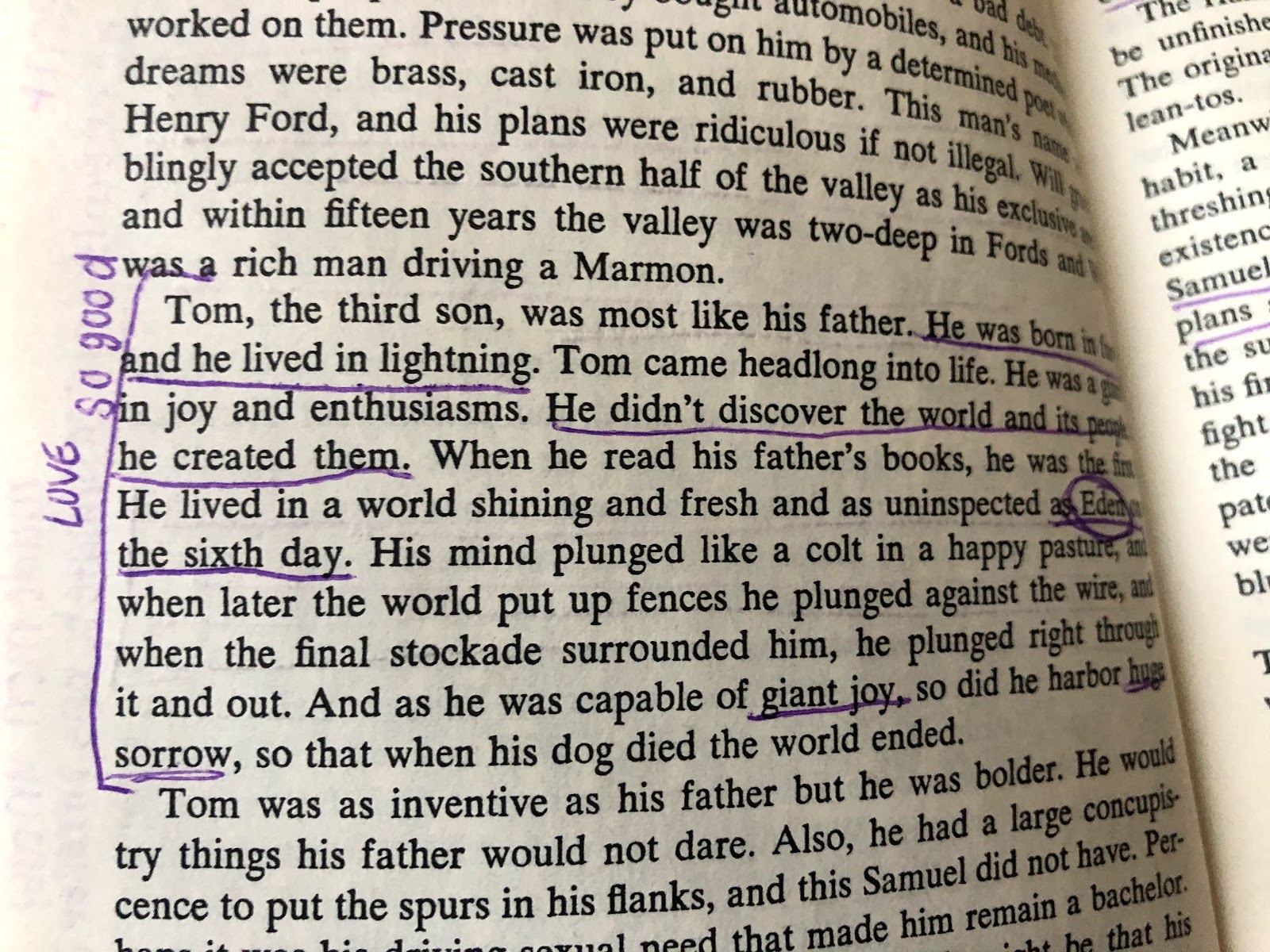
Junior year Sophie geeking out over Steinbeck's beautiful language. 
"I would like to share a student's paper as an example of what I was looking for in this assignment" said my AP Literature teacher, a casual remark that increased my heart rate, alertness, and hope for recognition. I had worked tirelessly on this paper, mirroring the stylistic methods utilized by some of my favorite authors in order to demonstrate my
proficiency in the English language. After a dramatic pause rivaling those of award show announcers, my teacher finally stated, "Sophie's paper was the perfect example of being creative and concise," proceeding to point out certain sentences where I had done particularly well. At last! I had finally been recognized for my hard work. Maybe I could pursue this English thing in college...


Tuesday, January 14, 2020

Sophie's Literary Moments

My golden experience (Reading Literature Privately)
The Goldfinch, written by Donna Tartt, was the first really challenging book I read on my own time. Eloquent and complicated (and very, very long), The Goldfinch really pushed me and changed the types of books that I aspire to read. The end of the novel was full of memorable quotes of self-doubt, identity, passion, and the purpose of life. I ended up marking and annotating quite a few passages, an activity I had previously only done in school books and utterly rejected in my own reading. But The Goldfinch conveyed such powerful messages so beautifully, and inspired me push my limits when it comes to literature.

Perfect vs. Good, and the Power to Choose (Discussing Literature) 
In my junior year AP Language and Composition class, we read one of my now-favorite books: John Steinbeck's East of Eden. Although the novel is wonderful and powerful when read alone, the discussions in class really broadened my understanding of what Steinbeck was trying to communicate. One especially memorable quote that we discussed was when Abra tells Cal: "And now that you don't have to be perfect, you can be good." When I first started the novel, I did not understand why that quote was so special, but through our discussions of 'timshel' and good vs. evil, it became one of my favorite literary quotes ever.

My experience with Beloved (Sublime Literary Experience)
Toni Morrison's masterpiece Beloved was a novel that truly shook me to the core. The descriptions of slavery and the challenges faced by African Americans in the United States, combined with the downright creepy subject matter of the novel, really freaked me out, but in the best way. Sometimes the ideas did get to the point where I had to put the book down and take a break, but I truly think that reading Beloved greatly contributed to my understanding of post-Civil War America and the evils of the slave trade.

Two roads diverged in a yellow wood... (Memorization of Literature) 
Freshman year of high school, I memorized Robert Frost's "The Road Not Taken" for my English class. Though I did not expect this at the time, I still have the poem (mostly) memorized today, and I like to remember it when I am faced with a decision. I truly have tried to live by the values communicated by Robert Frost, and they have encouraged me to take the road less traveled.

Theatre where Shakespeare's company performed (Theatrical Experience)
I have never been the biggest fan of Shakespeare's plays, but while I was studying abroad in London last spring, I had the opportunity to watch The Merry Wives of Windsor at the Globe Theatre. Although it was over 2 hours of uncomfortable standing in the cold and rain, I really felt transported and fascinated with Shakespeare's works as I had never been before. It was an experience so different than simply reading the play or watching it performed by a rudimentary high school cast.

The book is always better than the movie (Cinematic Literary Experience)
Reading To Kill a Mockingbird in my English class was probably the highlight of my freshman year. We also watched the movie as we read, and I developed an appreciation for the book even more. Although the 1962 movie is not the greatest movie ever, it allowed me to visualize and comprehend the messages communicated in the book on a deeper level.

Sunday, January 12, 2020

Sophie's Academic Writing Self-Assessment

I definitely enjoy academic writing more than creative writing, so it is useful for me to analyze my strengths and weaknesses when it comes to academic writing. I think my biggest weakness would be in coming up with ideas: once I have an idea to write about, I enjoy the writing process of communicating the idea. But, actually choosing what to write about is usually an arduous and time-consuming process. My biggest strength in academic writing would probably be my ability to support a claim well. I think I am good at staying focused in my writing and really finding the right evidence to support whatever it is I am arguing. I think an example of these weaknesses and strengths would be in my final English 251 paper: it took me hours to decide what to write about, but once I figured it out, I think I did a good job of supporting my thesis with textual evidence.

Tuesday, January 7, 2020